The importance AfCFTA?
The AfCFTA stands as a transformative initiative poised to reshape the economic landscape of the African continent. With its overarching goal of promoting intra-African trade, AfCFTA seeks to dismantle barriers to commerce by reducing or eliminating tariffs and fostering a more integrated market. Historically, African nations have faced challenges in trading among themselves, often prioritizing economic ties with non-African partners. AfCFTA addresses this by creating a unified market, encouraging member countries to leverage their comparative advantages, leading to increased production efficiency and economic diversification. By doing so, AfCFTA aims to spur economic growth, create job opportunities, and enhance the overall development prospects of participating nations.
Beyond its economic implications, AfCFTA holds the potential to foster political and social integration among African countries. By forging stronger ties and a shared commitment to regional development, the agreement contributes to a sense of unity and cooperation. The initiative also positions the continent as a more formidable player on the global economic stage, with a consolidated market that can enhance Africa’s negotiating power in international trade agreements. However, the success of AfCFTA hinges on effective implementation, addressing infrastructure challenges, ensuring regulatory harmonization, and promoting inclusive growth to benefit all member states equitably.

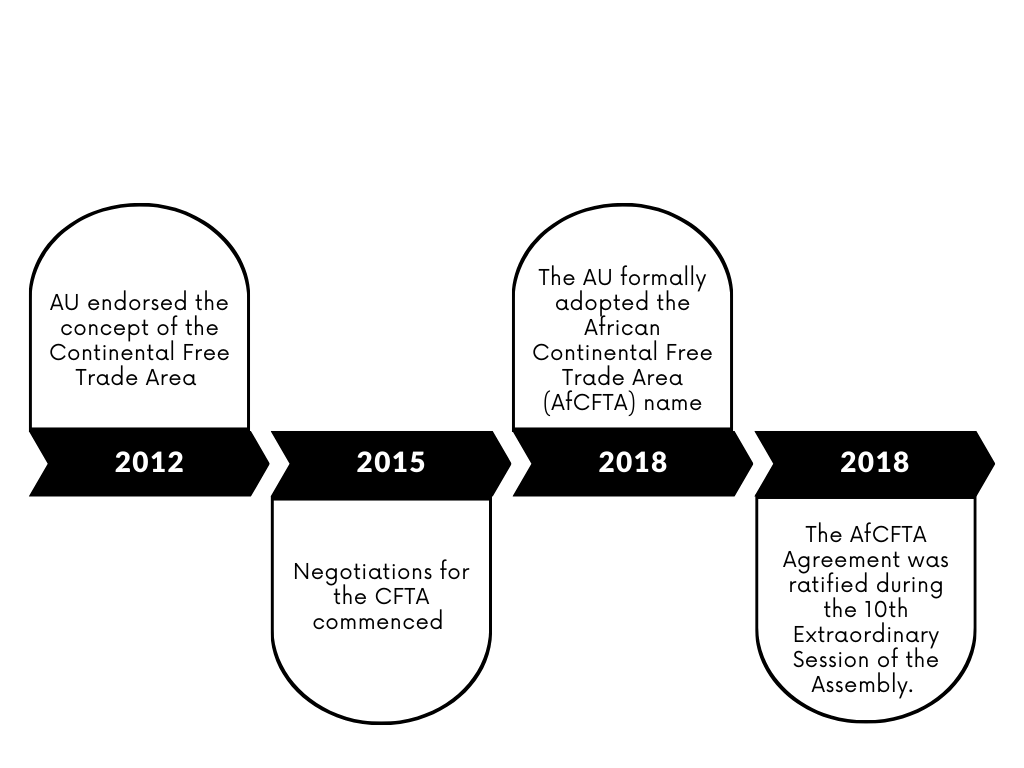
Milestones in the AfCFTA negotiations
In 2012, the Assembly of Heads of State and Government of the African Union (AU) endorsed the concept of the Continental Free Trade Area (CFTA). The AU’s 50-year vision and action plan, “Agenda 2063: The Africa We Want,” introduced in January 2015, outlines seven aspirations encompassing various development aspects. The CFTA stands out as a prominent initiative under the First Ten-Year Implementation Plan of the AU’s Agenda 2063.
Negotiations for the CFTA commenced in June 2015 during the AU’s Heads of State and Government meeting. The initial phase (Phase 1) of negotiations focused on trade in
goods and trade in services. The subsequent phase (Phase 2) will extend to cover areas such as Investment, Intellectual Property Rights, and Competition Policy.
In January 2018, the AU formally adopted the African Continental Free Trade Area (AfCFTA) name. The pivotal moment occurred on March 21, 2018, when the AfCFTA Agreement was ratified during the 10th Extraordinary Session of the Assembly in Kigali, Rwanda.
Why does Africa need the AfCFTA?
African trade integration has faced persistent challenges due to the degradation of border and transportation infrastructure, coupled with a complex array of unique regulations across numerous markets. Governments often impose trade barriers to shield their domestic markets from regional competition, resulting in higher costs for trading with neighboring countries compared to those situated much farther away.
As indicated in the 2019 Economic Development in Africa Report by UNCTAD, intra-African exports constituted 16.6% of total exports in 2017, contrasting sharply with Europe (68.1%), Asia (59.4%), America (55%), and Oceania (7%). The average for intra-African trade, encompassing both exports and imports, hovered around 15.2% from 2015 to 2017. Throughout the 2000-2017 period, Africa’s export dependency on the rest of the world ranged from 80% to 90%, with only Oceania exhibiting a higher reliance on external markets during that timeframe.