
The Legal Instruments Covered
The AfCFTA Agreement serves as the treaty establishing the African Continental Free Trade Area and incorporates Protocols on Trade in Goods, Trade in Services, Investment, Intellectual Property Rights, and Competition Policy.
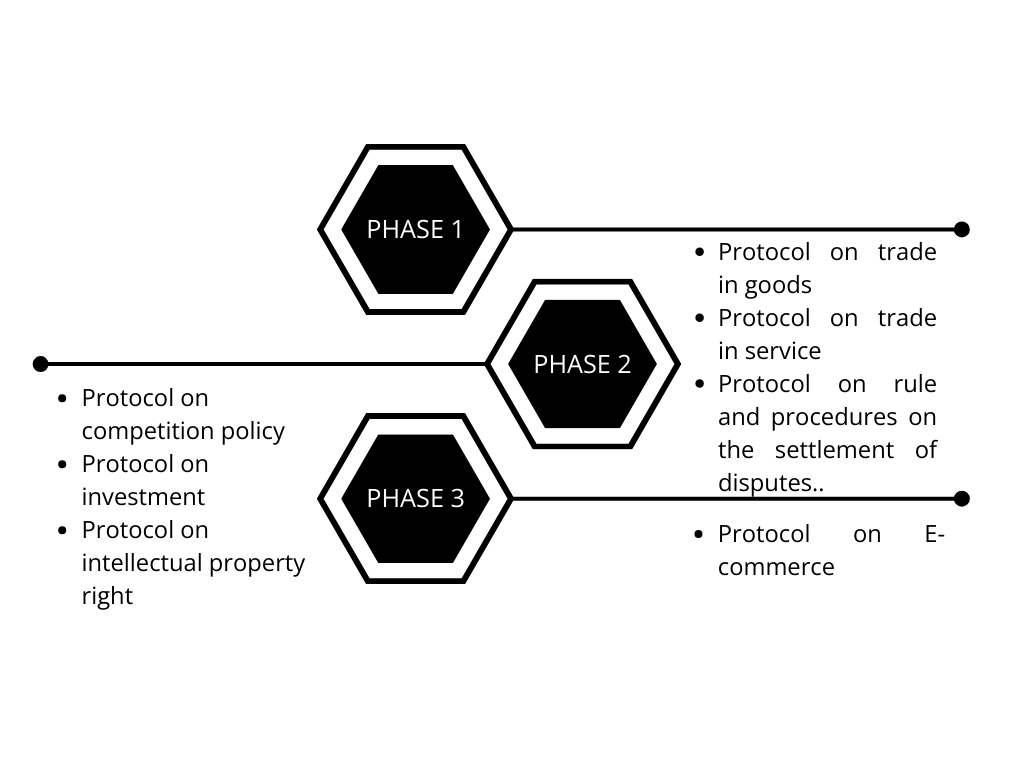
Negotiations for the AfCFTA progress through distinct phases. Phase I covers trade in goods and services, as well as dispute resolution. Phase II addresses investment, competition policy, and intellectual property rights. Notably, Phase III, added subsequently, will tackle e-commerce.
On May 30, 2019, the AfCFTA Agreement, Protocol on Trade in Goods and Services, and Protocol on Rules and Procedures for the Settlement of Disputes, along with their annexes and appendices, became legally binding. Ongoing discussions pertain to finalizing schedules of particular commitments for the five key service sectors (business services, communications, finance, tourism, and transport), with negotiations expected to conclude by June 2021.
While trade under AfCFTA rules awaits complete legal arrangements, the AU Summit, in December 2020, decided to permit trade under reciprocal offers from Phase I negotiations. However, this has yet to materialize, prompting Heads of State and Government at the 35th Ordinary Session of the AU Assembly (February 5-6, 2022) to determine that “commercially meaningful trade” should commence at a later date.
Distinguishing itself from traditional trade agreements focused solely on tariff reduction, the AfCFTA extends to the liberalization of services trade. Given that services constitute about 60% of Africa’s GDP and play a substantial role in global trade (30% in 2014), the commitment to progressive services liberalization involves opening domestic services markets to suppliers from other African countries.
Recognizing that non-tariff barriers, such as cumbersome customs procedures, often pose greater challenges than tariffs, the AfCFTA incorporates a “non-tariff barrier mechanism” to report and resolve such obstacles in intra-African trade. Additionally, provisions for the recognition of technical and sanitary standards, transit facilitation, and customs cooperation aim to significantly streamline cross-border business activities in Africa.
Expected outcome
AfCFTA is expected to usher in a new era of economic development in Africa by promoting intra-African trade. Anticipated outcomes include a significant increase in trade volume among participating nations, fostering economic growth, and creating job opportunities. AfCFTA encourages economic diversification, aiming to strengthen countries’ resilience and competitiveness. The agreement is also poised to drive infrastructure development, improve global competitiveness, and contribute to political and social integration among African nations. Moreover, AfCFTA emphasizes sustainability, incorporating principles for environmentally friendly and socially responsible economic activities. Success hinges on overcoming implementation challenges, such as addressing infrastructure limitations and ensuring equitable distribution of benefits among member states. Ongoing monitoring and adaptation will be crucial for maximizing AfCFTA’s positive impact on the continent.
Challenges
The implementation of the African Continental Free Trade Area (AfCFTA) faces several challenges that could impact its successful realization of economic integration across the continent. One significant hurdle is the diverse economic and developmental statuses of
participating countries. While some nations boast well-established industries and infrastructure, others struggle with underdeveloped systems, potentially leading to uneven benefits and opportunities. Bridging this developmental gap requires strategic planning and collaborative efforts to ensure that all member states can actively participate and derive advantages from the agreement.
Another major challenge is the need for harmonization of regulations and standards across diverse economies. Varied legal frameworks, trade policies, and technical standards among member countries can impede the smooth flow of goods and services. Achieving regulatory coherence is crucial to facilitating cross-border trade, but it demands extensive coordination and alignment of policies. Additionally, addressing non-tariff barriers, such as cumbersome customs procedures and logistical challenges, is essential for the effective functioning of AfCFTA and requires sustained efforts in capacity building and infrastructure development. Overcoming these challenges will be imperative for AfCFTA to realize its full potential and foster inclusive economic development across the African continent.